Stop Replaying Every Work Conversation
Learn how I stopped the social anxiety, rumination, and intrusive thoughts that replayed every work conversation I had, before the overthinking cost me my peace and my career.
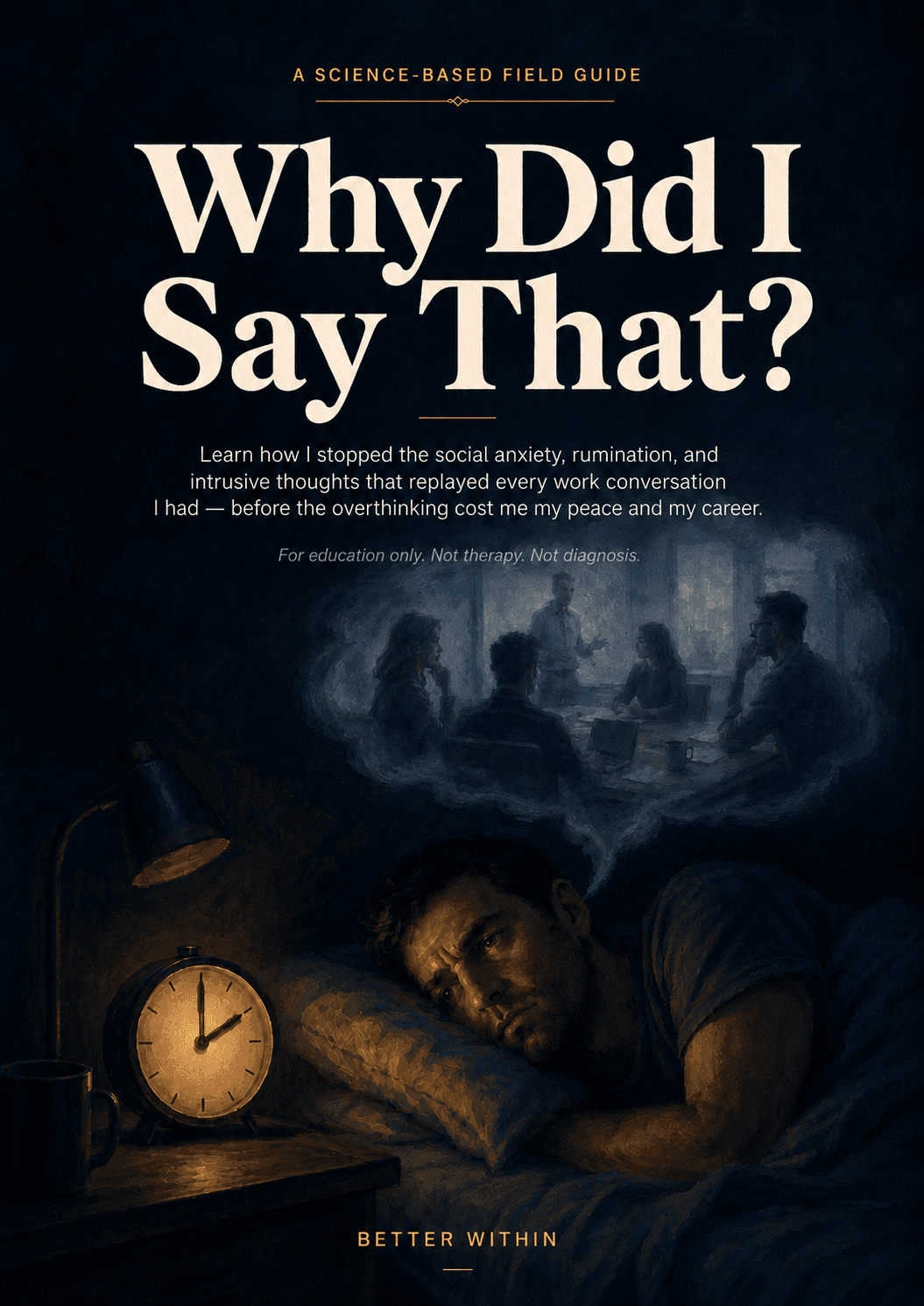
The meeting ended at 3 p.m.
Your brain didn't get the memo.
At 4 p.m. you're replaying the interruption. At 7 p.m. you're analyzing a colleague's face. At 2 a.m. you're running the whole meeting again, frame by frame, hunting for the exact second you ruined your reputation.
The sentence on loop
One slightly awkward line from a meeting plays on repeat — for hours, then days.
Re-read ten times
You draft and re-read messages hunting for the phrase that 'ruined everything.'
Silence feels safer
You stop speaking up — not because you have nothing to say, but to dodge the replay.
Wide awake at 2 a.m.
The meeting ended at 3 p.m. Your brain didn't get the memo. Frame by frame, again.
It has a name. Psychologists call it post-event processing — the review-and-replay loop that follows social situations. It's a core feature of social anxiety, and it's been studied for decades.
That matters for one reason: if it has a name, it has research. And if it has research, it has methods that have been tested on real people — not motivational quotes.
A short field guide, cover to cover in under an hour.
Eight chapters, three tools, one 14-day plan, a printable worksheet, and a reference list so every claim can be checked.
A Letter From Someone Who's Been There
What Your Brain Is Actually Doing at 2 A.M.
Why 'Just Stop Thinking About It' Always Fails
Nobody Noticed: The Spotlight Effect
Tool 1 — The Scheduled Review
Tool 2 — Watching the Replay From the Balcony
Tool 3 — Unhooking From the Thought
The Night Protocol: Ending the 2 A.M. Replays
The 14-Day Plan
What Peace Actually Feels Like
Your Worksheet
References
Three tools that break the loop.
Control the container, not the thought. Each tool comes from clinical psychology research — and each is something you can do tonight.
The Scheduled Review
Give the replay an appointment.
Stop fighting the worry — reschedule it. A fixed 15-minute daily window turns ambushes into entries on a list. Capture, don't chew. By review time, most of them already feel trivial.
Borkovec — worry postponement
The Balcony View
Watch the replay from the back of the room.
Switch from 'I' to your own name. Move the camera to the wide shot. Ask the friend question. Same event, different angle — radically different pain. The 4-second rule beats the felt minute.
Kross — self-distancing
Unhooking From the Thought
The thought still visits. It no longer runs the house.
A thought feels like news. Wrap it: 'I notice I'm having the thought that…' Name the station: Radio 2 A.M. Thank the smoke detector. You're not arguing — you're acknowledging and declining.
Hayes — ACT cognitive defusion
Knowledge doesn't break the loop.
Repetitions do.
One small addition at a time. Total daily cost: under 30 minutes. Missing a day is data, not failure — resume the next day at the same stage.
Observe & capture
Set your 15-minute review window. Capture every replay in one line. Redirect with 'booked for 6 p.m.' See with your own eyes how many are reruns.
Add the balcony
For the single hottest replay each day, run the balcony view: own-name self-talk, wide camera shot, friend question. Depth beats volume.
Add defusion
Now at the moment a replay strikes — not waiting for the window — apply the labeling frame, name the radio station, thank the smoke detector.
Add the night protocol
Pre-bed download, handover sentence, 15-minute rule, counting task. In one meeting, deliberately speak up — then run the balcony, not the anxious, review.
Not motivational quotes. Tested methods.
Every claim in the book traces back to a research program you can look up tonight. The plain-language summary below names who did the work — the reference list in the book gives you the rest.
"I left a meeting, got coffee, and realized an hour later that I hadn't reviewed the meeting once. The tape simply hadn't started."
What peace actually feels like — Chapter 9
The replays may never reach absolute zero — and that's fine. The skills you'll hold turn a resident into a passerby. And the career effects are real: when the tax on speaking collapses, your ideas come back into the room — and so do opportunities.
Run the fourteen days.
Then enjoy the silence.
Drop your email and we'll send the 24-page field guide straight to your inbox. Read it tonight. Start the plan tomorrow.